
The best cars for police chases in GTA 5
The fastest car is almost never the best one in a chase. Here's why, and what to take instead depending on whether you're running from the cops or a player.
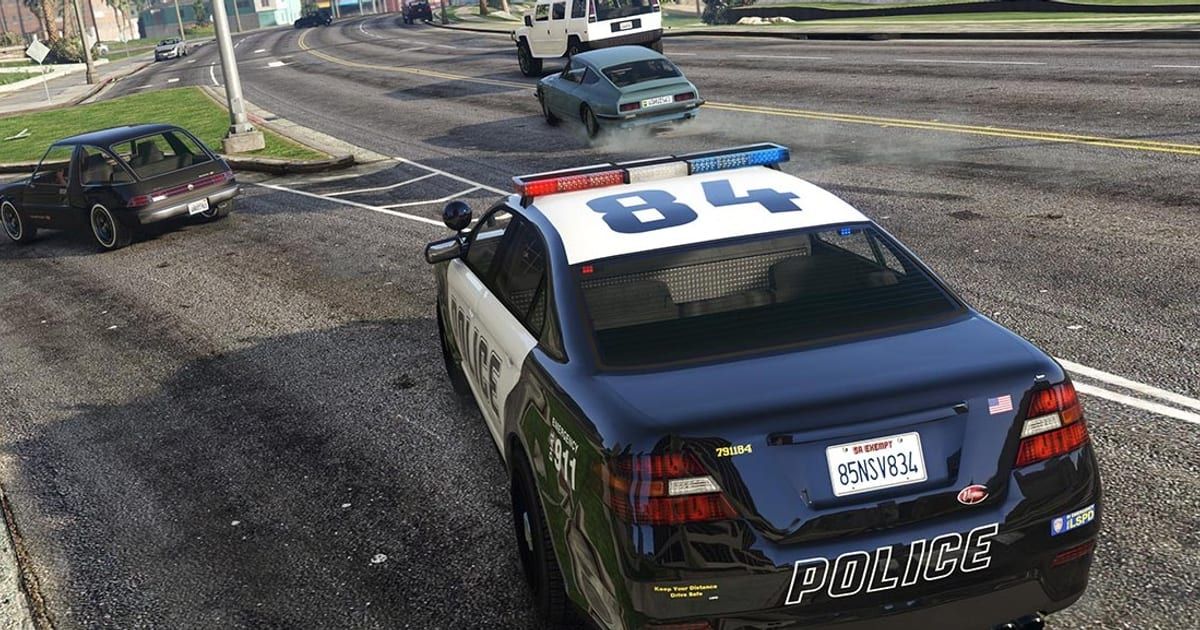
“What’s the best car for a chase in GTA 5?” The question comes up constantly, and the usual answer — a top 3 of the fastest cars — is almost always wrong. Because chases aren’t won in a straight line, and the right answer depends on who’s chasing you.
Why the fastest car loses chases
Top speed is the most-quoted stat and the least useful one. Across Los Santos you spend most of a chase at under half your maximum speed: corners, junctions, traffic, kerbs. A hypercar buys you an advantage on the two kilometres of uninterrupted freeway you’ll never actually get.
What decides the outcome:
- Roll-on acceleration between 40 and 80 mph. That’s the real speed band of an urban chase. A car that pulls hard out of a corner recovers more ground than one that tops out 25 mph higher.
- Stability under load. Very fast cars are often twitchy: clip one kerb and you’re facing the wrong way. A forgiving car costs you half a second per mistake instead of five.
- Traction, especially all-wheel drive. AWD lets you get back on the throttle earlier, cross a median or a patch of dirt without losing everything. In the rain the gap is enormous.
- Crash resistance. A chase means contact. A car that stalls or smokes after three hits doesn’t finish.
- Visibility and footprint. A wide car won’t thread between two vehicles in traffic. A small one goes anywhere.
Remember this: speed gains you ground, handling stops you losing it. And in a chase, you always lose ground faster than you gain it.
Losing the AI police (GTA Online and single-player)
Here your opponent isn’t a driver — it’s a system that spawns vehicles ahead of you and shoots at you. The criteria change completely.
- Karin Kuruma (Armored) — the historic pick, and it still holds. Its armoured windows make you near-untouchable to NPC gunfire. It’s neither the fastest nor the sharpest, but it solves the only problem that matters at high wanted levels: not dying. For reaching and holding five stars, nothing does it better.
- Western Sanchez (or any decent dirt bike) — the real escape technique isn’t going faster, it’s leaving the road. Police vehicles are terrible off-road. A dirt bike in the Vinewood hills or a riverbed loses them in seconds, where a supercar stays glued to tarmac with ten cars behind it.
- Flying and rocket-boosted vehicles (Oppressor Mk II, Deluxo) — let’s be honest, they don’t “win” the chase, they delete it. If you’re after fun, bad pick; if you just want to finish a mission, unbeatable.
The lesson: against AI police, survival and terrain beat speed. Nobody loses the cops by staying on the freeway.
Chases against players (FiveM, GTA RP)
Now everything changes: there’s a human out there who anticipates, cuts corners, and knows the map as well as you do. Armour is worthless, driving is everything.
What to look for:
- All-wheel drive for traction out of corners and tolerance for mistakes. The Elegy RH8 and Elegy Retro Custom, the Sultan RS and Sultan Classic are the long-standing references: fast, extremely stable, forgiving.
- A compact body. The Sentinel, the Futo, the Issi fit through gaps where a supercar gets stuck. In dense city driving that’s decisive.
- Versatility. The Buffalo STX, the Dominator, the Gauntlet take contact, hold the road, and don’t demand a perfect line.
- Ground clearance if you plan to cut. A car that accepts a kerb, a bank or a dirt track gives you options your pursuer doesn’t have.
And what to avoid:
- Bikes. Thrilling, often faster, but a single contact throws you off. Against a player looking for contact, that’s a death sentence.
- Twitchy hypercars (Pariah, Krieger, Itali RSX): sublime on a track, unmanageable through a junction at 120 mph with someone on your bumper.
- Heavy SUVs and 4x4s: they survive, but they never catch anything.
Quick reference
| Context | Priority | Solid picks |
|---|---|---|
| AI police, high wanted level | Survival | Armored Kuruma |
| Fast escape, off-road | Terrain | Sanchez, off-roaders |
| Player chase, city | Handling, footprint | Elegy, Sultan RS, Sentinel |
| Player chase, mixed city/road | Versatility | Buffalo STX, Dominator, Gauntlet |
| Pure freeway running | Top speed | Hypercars (Pariah, Emerus…) |
The four mistakes that cost you a chase
- Running straight down the freeway. That’s the pursuer’s terrain: straight line, no obstacles, clear line of sight. Chases are lost in traffic, alleys and elevation changes.
- Picking from the stat bars. In-game stats don’t reflect real behaviour. Two cars with near-identical numbers can drive completely differently.
- Not knowing the map. At equal driving skill, whoever knows where the alley comes out wins. It’s the most underrated factor, and the only one that improves for free: drive.
- Skipping the upgrades. Brakes, suspension and transmission change a car more than swapping models does. A fully upgraded Elegy beats a stock supercar in 90% of chase situations.
What if the car stops being a variable?
Everything above rests on one assumption: each side picks their own car. That’s what makes the topic interesting — and it’s also what makes chases unbalanced. Whoever grinded fifteen hours shows up better equipped, and you never really find out who the better driver was — GTA Online’s full garage runs into the thousands of euros.
That’s the problem we removed on Chased: in our 1v1 hunter-versus-hunted duels, the car is randomly drawn and identical for both players. Nobody picks, nobody buys, nobody has a hardware advantage. All that’s left is your line, your map knowledge and your nerve — exactly the criteria from the top of this article, minus the garage lottery.
To go further, see our FiveM drift techniques — mastering weight transfer is what separates good pursuers from the rest — and our pick of the best chase and drift servers. If you’re interested in weather as a tactical variable, changing the weather in GTA 5 and FiveM covers what rain does to your traction.